
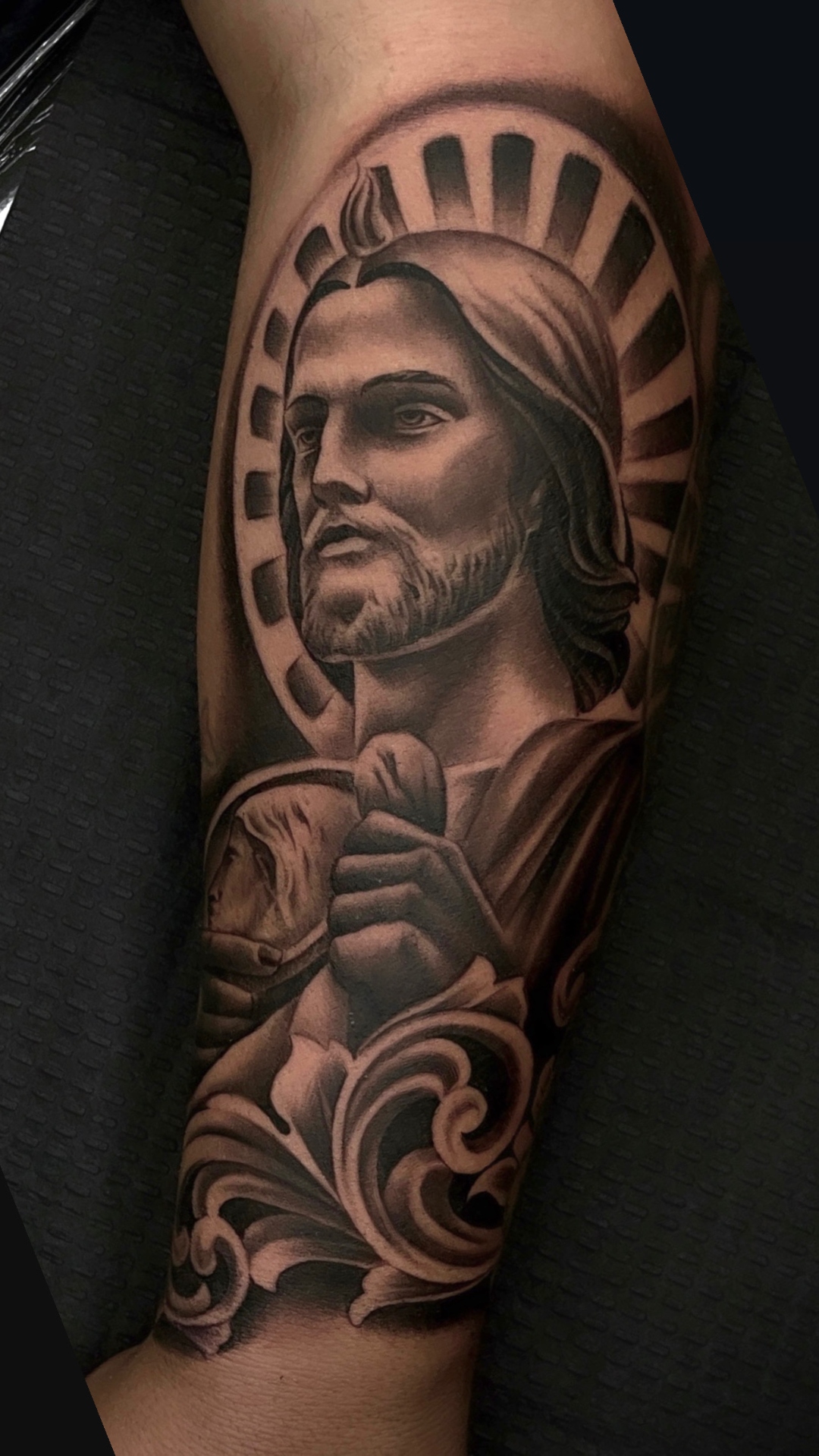
Most people do not walk away from a tattoo because they dislike the design. They walk away because of the number attached to it.
You sit down for a consultation with a clear picture in your head. A full sleeve. A back piece. The chest work you have been thinking about for three years. The artist quotes the project honestly, and suddenly the conversation shifts from what you want to what you can put on a card this month. So you scale it down. You take the half sleeve instead of the full one. You break it into pieces you will get around to eventually, and eventually turns into never.
That compromise is the single most common reason people end up with a collection of unrelated small tattoos instead of the cohesive work they actually pictured.
There is a better way to do this, and it is not complicated. It is the way a few hundred of our clients have already done it.
The Real Problem Is Not Cost, It Is Cash Flow
A $2,500 sleeve is not expensive in the way people think it is expensive. Spread across a year and a half, it is $146 a month. That is a phone bill. That is a gym membership and a couple of streaming services.
The reason it feels impossible is that traditional tattoo pricing asks you to produce the money in large chunks, session by session, on the day of the appointment. You pay $400 today, then $500 in six weeks, then $400 more when you can manage it. Every one of those payments is a decision point where life gets in the way, and every gap between sessions is a chance for the project to stall out.
Meanwhile the artwork sits half finished on your arm.
Financing solves a timing problem, not an affordability problem. It converts one large unpredictable expense into one small predictable one, and it moves the artwork from the future into the present.
How Our Clients Actually Use Affirm
Here is the part that most shops never explain, and it is the whole strategy.

Our clients do not finance one session. They finance the finished result.
Step one: define the end state
You come in and we talk about where this is going. Not "I want something on my forearm," but the full picture. Full sleeve from shoulder to wrist. Do you want the chest panel connected to it. Is this black and grey or color. Are we working around existing pieces or covering them.
This is a design conversation first. Our artists map the entire composition, including the parts we will not touch for a year, because a sleeve designed as a sleeve looks nothing like five separate tattoos that happen to be on the same arm.
Step two: price the whole project
Once the end state is defined, we quote the entire thing as one number. Not an hourly rate you have to guess at. Not a per session estimate that moves around. One project price for the finished work.
That number is the thing you finance.
Step three: one application, one monthly payment
You apply through Affirm, get approved for the project total, and from that point forward you have exactly one payment to think about: the fixed monthly amount you owe Affirm.
Step four: come in when it works for you
This is the part clients tell us changed everything. Once the project is financed, sessions are already paid for. You book when your schedule allows. You come in on a Tuesday afternoon because you had the day off. You take six weeks between sessions because you went on vacation, and it costs you nothing extra to do that.
You never pay another dollar at the shop. No deposit at each session. No card at the front desk on the way out. Nothing beyond the monthly payment you already agreed to with Affirm.
The artwork gets finished on the schedule the healing dictates, not the schedule your paycheck dictates.
One client financed a $2,500 sleeve and pays $146 a month. He came in eleven times over the following year. He never handed us a card again after the first appointment.
What Affirm Actually Costs
We are going to be specific here, because vagueness about money is how people get burned.
Affirm approves you based on your own credit profile, so we cannot promise you a rate. What we can tell you is how the product works, and it compares favorably to almost every other way of paying over time.
The rate depends on you
Affirm offers payment plans at a rate of 0 to 36% APR based on the customer's credit, and some offers are 0% APR (Affirm). Where you land inside that range is between you and Affirm. Strong credit can mean no interest at all.
There are no late fees, ever
This is the part that separates Affirm from a credit card. Affirm does not charge late fees, penalties, deferred interest, or compound interest, and states that consumers are never charged late or hidden fees even if they miss a payment (Affirm investor materials).
Miss a payment on a credit card and you get a fee plus interest on the fee. Miss one with Affirm and you do not get punished for it.
The interest never compounds
Interest on Affirm plans is simple interest, based on a fixed percentage agreed to up front, and it never compounds (Affirm investor materials). Affirm's own description of the product is upfront interest, no late fees, and offers as low as 0% APR (Affirm).
What that means practically: the total you see at approval is the total you pay. The number cannot grow while you are not looking. This is the opposite of carrying a tattoo on a credit card, where a minimum payment habit can quietly turn $2,500 into considerably more.
Our numbers
- Minimum project: $500. Below that, financing is not worth the paperwork and we will just book you.
- Typical term: 6 to 18 months. Most clients choose based on the monthly number they want to hit rather than the term itself.
- Hundreds of tattoos financed. We have used Affirm for several hundred projects at this point. This is a routine part of how our shop operates, not an experiment.
How This Compares to the Other Ways People Pay
Financing a tattoo is not the only option, and it is worth seeing it next to the alternatives honestly.
Paying per session with cash or a card
This is what most people do. It works fine for small pieces and it is the worst possible option for large ones. You are exposed to every fluctuation in your own cash flow across a project that might span a year, and the artwork stops whenever money is tight. There is also no commitment mechanism, which sounds like freedom and functions like procrastination.
Putting it on a credit card
A credit card will absolutely get the tattoo done today. The problem is what happens afterward. Carrying a balance means compounding interest, minimum payments that stretch the debt far longer than you intended, and late fees if you slip. Affirm's interest is simple and fixed at the outset rather than compounding, and there are no late fees at all (Affirm investor materials). If you are going to pay over time either way, a fixed plan with a known total is the more predictable instrument.
Informal shop payment plans
Plenty of shops will let you pay in chunks or hold a design while you save. There is nothing wrong with that, and for smaller work it can be the simplest path. But it is not a financing product. There is no fixed term, no defined total, and the shop is carrying the risk, which usually means the work does not start until the money is largely in hand. That defeats the purpose if your goal is to begin now.
What the financed approach changes
The difference is not really the money. It is that the project becomes a single decision made once, at the beginning, with a known endpoint. Everything after that is scheduling.
Why This Works Better for Large Scale Work
Financing is useful for a $600 piece. It is transformative for a $3,000 one, and it is worth understanding why.

Large projects get designed better
An artist who knows the full budget up front designs for the full budget. They can place the focal point where it belongs, leave negative space that will make sense later, and plan how the composition flows across the arm or the back. When a project is funded piece by piece, the artist is designing blind, adding to whatever exists and hoping it resolves.
The single biggest quality difference between a great sleeve and an awkward one is whether it was planned as a whole. Financing is what makes planning as a whole possible.
You stop losing momentum
Half finished large work is extremely common, and the reason is almost always financial rather than artistic. Someone gets two sessions in, life happens, and the third session never gets booked. Two years later they are looking at an unresolved piece and deciding whether to start over.
When the project is already paid for, there is no financial reason to stop. The only thing setting the pace is healing.
Volume becomes realistic
Some clients are not doing one large piece, they are doing quantity. Six or eight separate tattoos planned as a set. A leg filled in over a year. Knuckles, hands, and a neck piece as a coordinated group.
Priced individually, that is a series of decisions you will talk yourself out of. Priced as one project and financed as one project, it becomes a plan with a completion date.
A concrete example of end state planning
Suppose you want a full sleeve built around black and grey realism, with a portrait as the centerpiece.
Planned as a whole, the artist places the portrait where the arm is flattest and the skin holds detail best, builds the surrounding elements to frame it, and leaves deliberate open space so the composition breathes. Sessions are sequenced so that related areas heal together. The last session is a unifying pass that ties the whole thing into one piece.
Built piecemeal over three years with three separate budget decisions, the same client typically ends up with the portrait wherever it happened to be convenient at the time, filler added later to bridge awkward gaps, and inconsistent contrast because the pieces were done at different times by different hands in different moods. It reads as a collection rather than a composition.
Same arm. Same money in the end. Completely different result, decided entirely by whether the project was planned and funded as one thing.
You get the artist you want
Here is an underrated benefit. When budget is the constraint, people shop for whoever is cheapest and available. When budget is handled, people book the artist whose portfolio actually matches the work they want.
That is how you end up with a tattoo you are still happy with in fifteen years. Choosing an artist for their specialty instead of their price is the highest leverage decision in this entire process, and financing is often what unlocks it.
What Financing Does Not Do
A sales pitch with no caveats is not worth trusting, so here are the honest limits.
It does not make a tattoo cheaper. If your rate is above 0%, you will pay somewhat more than the cash price. You are buying time, and time has a price. For most people the trade is obviously worth it, but we are not going to pretend the math is free.
It does not replace a real conversation about scope. We are not going to encourage you to finance a project that is larger than you actually want in order to hit a bigger number. If the right answer is a smaller piece, our artists will tell you that. We would rather do good work you love than large work you regret.
It is not a substitute for choosing well. Financing a tattoo from an artist who is wrong for the style is worse than not getting it. It just means you are paying monthly for something you do not love. Look at healed work, look at specialization, and pick deliberately. We wrote a full guide to spotting the right shop in San Antonio for exactly this reason.
Approval is not guaranteed. Affirm underwrites each transaction. We do not make that decision and we cannot influence it.
Why Clients Finance With Final Touch Tattoo Specifically
If you are going to commit to a project over a year, the shop matters more than it would for a single small piece. You are going to be spending a lot of hours in that room.
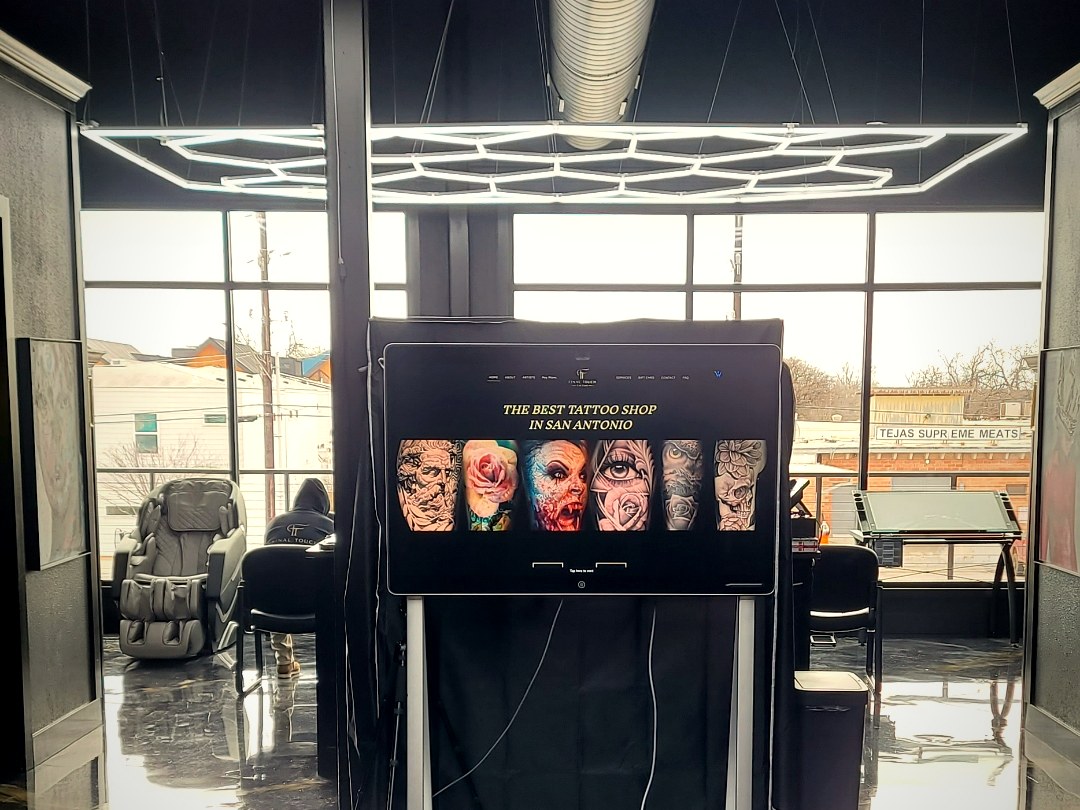
The work and the recognition
Final Touch Tattoo is the highest rated tattoo shop in San Antonio, with award winning artists, and we have been nominated as the best tattoo shop in San Antonio every year we have been open. Our piercer, Kara Pena, is the highest rated piercer in San Antonio.
The room you will actually sit in
A six hour session is a very different experience depending on where you are sitting. Every client gets a room rather than a chair in a row. Every room has a TV. We have massage chairs, food and water, a PS5, a headset for every client, and blanket service.
None of that makes the linework better. It makes a long session something you can actually do without dreading it, which matters enormously when your project involves ten of them.
The piercing side
Kara uses implant grade titanium and gold. Not "surgical steel," which is a marketing phrase rather than a material standard. If you are financing a larger project and want to add piercings along the way, you are working with someone who takes the jewelry specification as seriously as the placement.
One number, honestly quoted
The most important thing we offer a financing client is a project price we intend to honor. You cannot plan around a number that moves. Our artists scope the whole thing, tell you what it costs, and stick to it.
How to Start
- Book a consultation. Free, no obligation, in person or by phone. Bring reference images if you have them and a rough idea of scale.
- Define the end state with your artist. This is the part that matters most. Be ambitious here, because you are about to make it affordable.
- Get the project price. One number for the finished work.
- Apply through Affirm. Minimum $500. Terms typically run 6 to 18 months.
- Book your first session and keep coming back. Nothing further to pay at the shop.
If you have been putting off the piece you actually want because of the number, the number is not the obstacle you think it is. Come talk to us about the whole thing and let us price it properly.
Book a consultation · See payment plan details · Meet the artists · See the portfolios
Final Touch Tattoo, 227 E Cevallos St, Suite 202, San Antonio, TX 78204. (210) 248-9682.
Frequently Asked Questions
Do tattoo shops in San Antonio offer payment plans?
Some do. Final Touch Tattoo offers financing through Affirm on projects of $500 and up, with terms that typically run 6 to 18 months. We have used it for several hundred tattoos. Ask any shop directly, because informal in house arrangements are very different from a real financing product with fixed terms.
Can I use Affirm to pay for a tattoo?
Yes, at shops that accept it. At Final Touch Tattoo you apply for the total project cost, get approved based on your own credit, and then pay Affirm monthly rather than paying the shop per session.
What does Affirm cost on a tattoo?
Affirm offers rates of 0 to 36% APR depending on your credit, with some offers at 0% APR (Affirm). There are no late fees and interest is simple rather than compounding (Affirm investor materials). Your specific rate is determined by Affirm at approval.
How much is a sleeve tattoo per month with financing?
It depends on the project price, your approved rate, and your term. As a real example, one of our clients financed a $2,500 sleeve and pays $146 a month.
Do I have to pay anything at each session?
No. Once the project is financed, your sessions are covered. Your only ongoing payment is the monthly amount to Affirm. You do not pay the shop again as the work progresses.
What is the minimum amount I can finance?
$500. Below that we will simply book the appointment.
Can I finance multiple tattoos instead of one big piece?
Yes. Clients regularly plan a set of tattoos as a single project, price the group together, and finance it as one total. It is the same process as a sleeve.
Will applying hurt my credit score?
That is determined by Affirm, not by us, and it depends on the specific offer. Check Affirm's current disclosures when you apply so you know exactly what you are agreeing to before you commit.
Sources: Affirm · Affirm Investor Relations