
Final Touch Tattoo in San Antonio offers fine line and single-needle tattoos at 227 E Cevallos St, Suite 202, with free consultations, walk-ins welcome, and appointments encouraged. The studio is open Wednesday–Sunday 12pm–8pm, so you can discuss a small, deliberate design before committing to it.
- StudioFinal Touch Tattoo · Southtown, San Antonio
- Address227 E Cevallos St, Suite 202, San Antonio, TX 78204
- Phone(210) 248-9682
- HoursWed–Sun 12pm–8pm
- Rating5.0 average from 860 reviews
- Walk-insWelcome · appointments encouraged
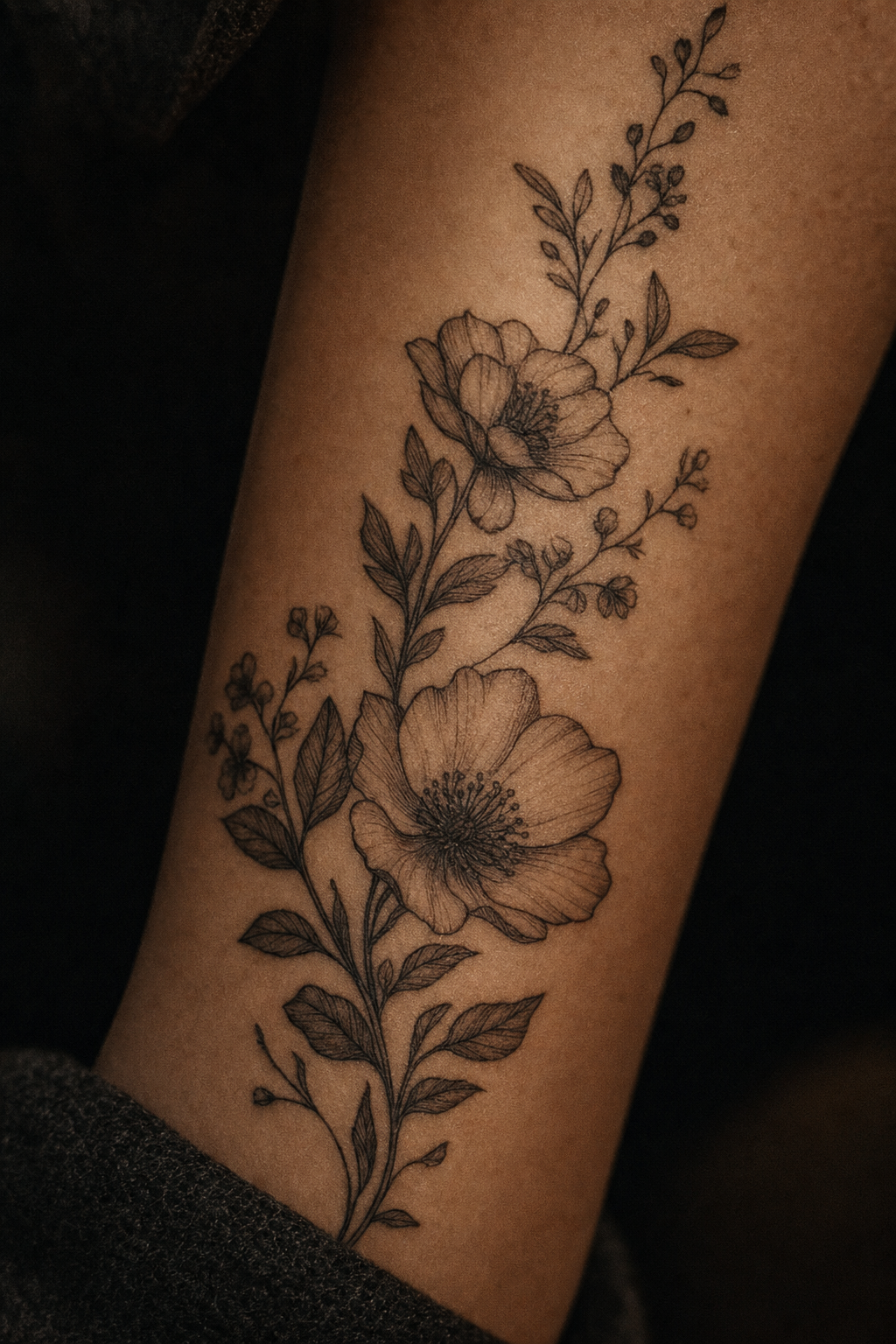
A fine line tattoo should look intentional up close and still make sense from a normal viewing distance. That matters whether you want a small symbol, delicate script, a botanical piece, or a compact micro-realism design. For a fine line tattoo San Antonio design, a saved image can look clean on a phone. The useful question is whether that same design has enough room, contrast, and line weight to remain clear on skin.
Fine line is not a shortcut version of a larger tattoo. It is a technical approach built around very small needle groupings, thin consistent lines, and minimal or no shading. The result can be quiet and detailed, but it gives the artist less margin for error. A single wobble, an overcrowded shape, or lettering that is too small stays visible because there is not much surrounding shading to distract from it.
Final Touch Tattoo offers fine line and single-needle work alongside custom tattoo design. Start by looking through the gallery, then use a free consultation to talk through size, placement, reference images, and the version of your idea that is likely to hold up. If your concept leans toward a darker, fuller treatment, compare it with black and grey tattoo work before choosing the approach.
What fine line tattooing actually means
Fine line work uses very small needle groupings to place narrow, controlled lines in the skin. A single-needle tattoo is one form of fine line work, but the terms are not always interchangeable: an artist may use a small grouping when the design needs a line that is still delicate but more reliable. Good fine line is not simply faint. The lines should be deliberate, consistent, and spaced so the image reads without relying on heavy fills.
Minimal shading is part of the look, not an accident. A botanical stem may need only linework and a few restrained shadows; a tiny portrait may use selective texture instead of a dark background. That restraint is why a minimalist tattoo San Antonio design needs editing before it needs decoration. Every line has a job. If two lines are too close together or a small area is packed with detail, the design may look precise on paper but crowded after it becomes a tattoo.
Why delicate work is harder than it looks
Fine line is unforgiving because thin linework puts accuracy on display. There is little shading to hide an unsteady pass, uneven spacing, or a shape that is out of balance. Curves, circles, and straight script baselines make those problems easier to see. The goal is not to force every detail from a reference photo into a smaller space. The goal is to keep the features that let the design read cleanly.
This is also why preparation matters. Bring clear reference images, the exact words and spelling for a delicate script tattoo, and a realistic sense of where you want it. Be ready to discuss what part of the reference you care about most: the flower type, the handwriting feel, the silhouette, or a specific facial feature. You can meet the artists and review the studio’s broader tattoo services before the conversation. Zellie does award-winning illustrative work.
How fine line ages and where it holds best
The most important thing to understand is that fine line ages differently from bold work. Thin lines place less pigment in the skin, so they can soften and spread over years. That does not make fine line a bad choice. It means the design must allow for change. Space between letters, leaves, or facial features gives the tattoo room to remain readable instead of slowly merging into a darker shape.
Placement strongly affects how well fine line holds. The forearm, outer upper arm, calf, shoulder blade, and back generally give a design more stable real estate. Fingers, hands, feet, ribs, inner wrist, and areas with heavy friction or thin skin are higher-risk choices for delicate work. Movement, rubbing, and frequent contact can make a precise small tattoo less predictable. A good placement is not just the place that looks best in a mirror; it is the place that supports the life of the tattoo.
Size, script, and detail need a minimum
Very small text and tight detail have a minimum legible size. If the letters are reduced past that point, the spaces inside and between them become too narrow to stay distinct. Over time, the words can thicken together, lose their clean gaps, or become difficult to read. The same rule applies to tiny petals, eyelashes, geographic lines, fingerprints, and the light-and-dark features in micro-realism. Smaller is not always more refined.
For a small tattoo San Antonio design, simplify before shrinking. Use fewer words, choose a clearer letterform, remove background texture, or make a meaningful symbol slightly larger. A good test is to look at the idea at the size it will be tattooed, not at full size on a screen. If you cannot immediately tell what it is from a short distance, it likely needs more space, cleaner shapes, or a different placement.
Design for the tattoo you will have in ten years
A durable fine line design starts with a readable silhouette and enough negative space. Pick the few details that carry the meaning, then let the rest go. Script needs breathing room around each letter. Florals need separation between stems and petals. A face needs the features that identify it, not every pore from a photograph. This approach does not make a piece less personal. It gives the personal parts a better chance of staying visible as the tattoo softens.
Final Touch Tattoo will tell you when a requested fine line design is too small or badly placed to hold rather than take your money for a version that is unlikely to age well. That is the point of a consultation: revise the scale, placement, or level of detail before the tattoo begins. To start that conversation, use the contact page and bring the idea you want, plus room for an honest recommendation.
South Texas sun is another design decision after the appointment. UV exposure can fade tattoo pigment and reduce contrast, especially in work that depends on subtle lines. Once the tattoo is fully healed, protect exposed skin with shade, clothing, and broad-spectrum sunscreen as part of your normal routine. The goal is not to promise that a tattoo will never change. It is to limit avoidable fading so the linework keeps more of its definition.