

- Inspect close-up photos: Demand macro shots where skin pores are visible, not photos taken five feet back or graded in pitch-black ring-light rooms.
- Check for healed work: Fresh ointment and swelling hide shallow lines and muddy grey wash. Look for settled work and clean skin texture.
- Verify Texas DSHS licensing: Every legal Texas shop holds an active Texas Department of State Health Services license, wraps stations in medical barrier film, and opens sterile single-use needles in front of you.
- Already got burned? Our 13-to-23-year veterans specialize in rescuing patchy tattoos with precision reworks and custom tattoo cover-ups in San Antonio.
In our companion article on how the tattoo industry shifted for San Antonio clients, we explained why there are more tattoo shops operating today than there were full-time tattoo artists a decade ago. The post-pandemic wave of online "six-figure tattoo courses" and cheap equipment flooded cities like San Antonio with unvetted operators chasing quick cash, while at the same time giving clients more choices than ever before.
Having more options is a huge win for clients, but only if you know how to separate truly good tattoo artists in San Antonio from someone who only knows how to edit an Instagram Reel. Most clients are not taught what a clean dermal line looks like up close, how black and grey shading settles after four weeks of healing, or what hospital-grade cross-contamination control looks like inside a Texas Department of State Health Services (DSHS) licensed studio. They see a fresh tattoo glistening under a dark-room ring light, or a photo taken five feet away, and they assume the work is solid until it heals blurry, raised, or patchy.
Whether you are vetting reputable tattoo shops in San Antonio for your next custom piece, looking for a clean tattoo and piercing studio in Southtown or near Downtown, or trying to figure out how to rework or cover up a bad tattoo you got somewhere else, this field guide gives you the exact visual, technical, and safety checklist our veteran artists use at Final Touch Tattoo and Piercing Studio.
Part 1: How Bad Tattoo Work Hides on Instagram and TikTok
Social media is the number one discovery tool for tattoos today, and it is also the easiest place to fake competence. When you are comparing portfolios to find good tattoo artists in San Antonio, watch out for these five photography and portfolio tricks that mask weak technical execution:
1. The Five-Foot-Back Photo Trick
If almost every photo on an artist's grid is framed from across the room showing the client's entire torso, outfit, and studio backdrop, ask yourself why you cannot see the ink up close. At a distance of four or five feet, your eye blends shaky lines, missed connections, and patchy shading into a recognizable silhouette.
A confident, experienced tattoo artist is proud to show you macro shots where the camera is inches away from the skin. When you inspect the Final Touch Tattoo gallery or our black and grey tattoos in San Antonio, you can zoom right in and see individual skin pores, crisp needle tracks, and smooth gradient transitions without blurring or distance tricks.

2. Polarized Ring Lights, Dark Rooms, and Heavy Contrast Filters
In the past four years, clip-on circular polarizing lenses paired with high-intensity LED ring lights inside pitch-black rooms have become standard gear for social media tattooers. A polarizer cuts glare off fresh ointment, which is fine by itself, but when an artist combines it with crushed black levels and boosted saturation in a photo app, it turns muddy, overworked grey wash into jet-black velvet on a phone screen.
Here is the dead giveaway: look at the client's untattooed skin around the tattoo. If the surrounding skin looks strangely orange, overly smooth like plastic, or vanishes into a black vignette, the image has been heavily graded. Compare that with Zellie's full-color Phantump tattoo below, photographed outside in honest natural Texas daylight where you can judge the true pigment saturation and natural skin tone with zero studio lighting tricks.

3. Zero Healed Tattoo Photos Anywhere in the Portfolio
Any tattoo can look passable for the fifteen minutes between the final wipe and the bandage wrap. Fresh skin is swollen, which temporarily plumps up weak lines, and fresh ink sitting in the upper epidermis (the outer layer of skin that sheds over the first two to four weeks) makes even shallow, uneven shading look dark.
According to the American Academy of Dermatology's medical guidance on caring for tattooed skin, your skin goes through a multi-week regeneration cycle as the epidermis peels and the permanent pigment settles inside the dermis underneath. If an artist has hundreds of fresh photos on their page and not a single healed highlight reel or returning client photo showing settled work, you have no proof that their ink actually stays in the skin without blowing out or falling out.
4. Red, Chewed-Up, or Weeping Skin in Fresh Photos
Zoom in on the skin directly inside the shaded and colored areas of an artist's fresh photos. Even on a brand-new tattoo, the skin surface should look intact, with visible natural skin texture. If the skin looks raw like scraped pavement, excessively swollen, or pitted with tiny blood craters, the artist overworked the skin by running too high a voltage, using poor hand speed, or raking the needles over the same spot ten times trying to force ink in. Overworked skin forms thick scabs, takes weeks longer to heal, and frequently leaves permanent raised scar tissue and patchy color loss.
5. Stolen Reference Photos and Uncredited Pinterest Boards
As we exposed in our YouTube reaction episode We Can't Believe These Tattoos Are Real and our viral red-flag breakdown When Tattoo Artists Take it Too Far - We React, some unethical operators populate their booking pages with Pinterest photos of other artists' tattoos and claim they can replicate them for a bargain-basement price, or charge outrageous "concept fees" for designs lifted straight off Etsy and Google Images. Always check whether the background, lighting, chair wraps, and studio floors in an artist's portfolio actually match a real, verifiable San Antonio tattoo shop.
Part 2: How to Inspect Linework, Shading, and Color Saturation Like a Pro
Even if you have never picked up a tattoo machine, you can evaluate technical quality in about sixty seconds once you know the four fundamentals that separate a 20-year veteran from an under-trained scratcher.
1. Clean Dermal Linework vs. Tattoo Blowouts and Holiday Gaps
A tattoo needle has to deposit ink at a very specific depth in the dermis, roughly 1 to 2 millimeters below the surface depending on where on the body you are getting tattooed.
- If the artist goes too shallow, the ink sits in the outer epidermis. As the tattoo peels during week two, sections of the line flake right off, leaving pale, broken gaps (which tattooers call "holidays").
- If the artist pushes too deep or angles the needle into thin skin, the ink punches through the dermis into the loose fat layer underneath. Once ink hits that subcutaneous layer, it spreads sideways like marker on a wet paper towel. That is a tattoo blowout, and it creates a permanent blurry blue or grey halo around the line within days.
- If the artist does not stretch the skin properly with their non-tattooing hand, the needle bounces or snags, producing wobbly lines, depth changes, and dark knots where two lines cross.
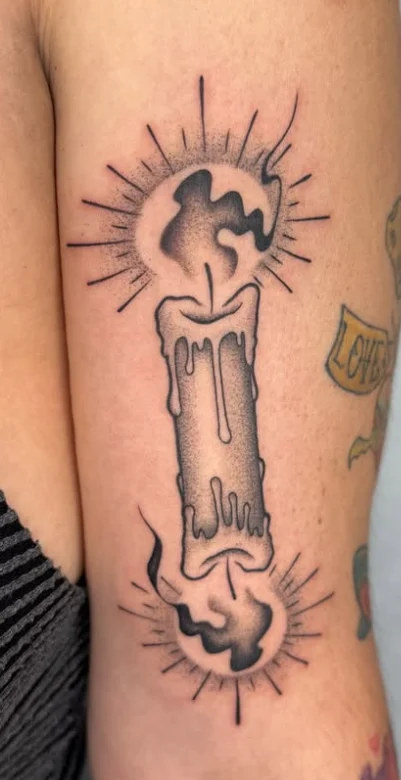
Compare those mistakes with the close-up fine-line and illustrative work from our Southtown studio below. In Raymond's custom double-ended candle on our San Antonio fine line tattoo page and Yvonne's black-and-grey skull-back spider and web, every line enters and exits cleanly, curves stay smooth without flat spots, and fine intersections meet without pooling or blowout halos.

2. Smooth Black and Grey Transitions vs. Muddy Scratch Marks
In black and grey realism tattoos, longevity depends on two things: smooth whip or pendulum shading and high contrast using open skin. When an inexperienced artist tries to shade a portrait or sleeve without proper mentorship, you will see visible "mag lines" (parallel rake marks left by the corners of a flat magnum needle grouping) and a uniform, muddy mid-grey tone across the entire tattoo. Six months later, when the tattoo settles and loses 15 to 20 percent of its initial fresh sharpness, a low-contrast grey tattoo turns into an unreadable smudge.
Now look at Moses's forearm butterfly composition below. With 23 years of tattooing experience, Moses anchors the design with deep, saturated blacks in the wings and drop shadows, feathers the mid-tones smoothly without visible needle tracks, and leaves strategic areas of clean, untouched skin so the highlights pop for decades.

3. Wall-to-Wall Color Packing vs. Patchy, Scratched Pigment
Color tattooing is one of the fastest ways to spot an inexperienced artist. Packing solid color requires moving the needle in tight, overlapping motions at the exact right voltage and hand speed so pigment fills the dermis evenly without shredding the skin. Bad color work looks streaky right out of the chair, stops short of the black outline (leaving a thin gap of blank skin around the edges), or looks chewed up and bloody.
Look at Canada's neo-traditional teal and pink rose below. With over 20 years of studio experience, Canada packs the teal petals, magenta folds, and carved yellow wood stem cleanly right up to the inner edge of the bold black linework, with zero gaps and zero surface trauma.

Part 3: The Clean Tattoo Shop & Safe Piercing Checklist for Texas Clients
Great artwork means nothing if a shop cuts corners on sterilization and bloodborne pathogen safety. Because every tattoo and body piercing breaks the skin barrier, both federal workplace safety rules and Texas state law treat tattoo and piercing studios as regulated health environments.
When you walk into any shop in San Antonio, whether for a consultation or a walk-in tattoo or piercing, look for these six non-negotiable hygiene standards before anyone touches your skin:
1. Active Texas DSHS Studio License and Posted Inspection Records
Under Texas Health and Safety Code Chapter 146 and the Texas DSHS licensing requirements for tattoo and body piercing studios, every legitimate tattoo and body piercing studio in Texas must hold an active state license, display it visibly, and submit to state health inspections. You can verify any shop in seconds using the Texas DSHS public license verification database. Under 25 Texas Administrative Code Section 229.406, licensed studios must also verify client identification and age and retain client and sterilization records for a minimum of two years. If someone tries to tattoo you in an apartment, hotel room, house, or unlicensed back room, walk out immediately.
2. Sterile Single-Use Needles Opened in Front of You and Red Biohazard Sharps Containers
Under both 25 Texas Administrative Code Section 229.409 and OSHA's Bloodborne Pathogens Standard (29 CFR 1910.1030) (see OSHA's official tattoo and body piercing interpretation), every needle and razor must be sterile, single-use, opened from sealed packaging with a lot number and sterilization indicator in front of you, and disposed of immediately after use into a puncture-resistant, labeled sharps container.
3. Complete Barrier Film Wrapping and Strict Glove Discipline
Look closely at the artist's station before they begin. In a clean tattoo shop, the tattoo machine grip, battery or clip cord, wash squeeze bottle, lamp handle, armrest, and tattoo chair are wrapped in fresh disposable plastic barrier film for every single client. Notice in the photo of Moses's owl tattoo above how the armrest under the client's forearm is completely encased in blue barrier wrap.
Just as important is glove discipline. In our YouTube reaction videos We Cannot Believe People Actually Made These Videos and Pro Piercer Reacts to Failed TikTok Piercings, our team calls out viral clips where artists tattoo without gloves, wear rings, watches, and bracelets pressed against the sterile glove cuff, or touch their cell phone, iPad, or studio doorknob with gloved hands and then go right back to wiping an open tattoo. The second a gloved hand touches a phone or an unwrapped surface, those gloves are contaminated and must come off.
4. Reputable Tattoo Inks and Never Diluting Ink With Tap Water
Many clients are shocked to learn that tattoo ink contamination is a documented medical hazard when shops buy cheap, unvetted pigments or dilute black ink improperly. The U.S. Food and Drug Administration's consumer guide on tattoo safety and the FDA's final guidance on microbial contamination in tattoo inks document 18 voluntary ink recalls between 2003 and 2024 due to bacterial and fungal contamination. In fact, CBS News reported on FDA laboratory testing showing that nearly a quarter of tested commercial tattoo and permanent makeup inks contained bacterial contamination.
Furthermore, the Centers for Disease Control and Prevention (CDC) MMWR investigation into tattoo-associated nontuberculous mycobacterial skin infections proved that diluting black ink with tap water or non-sterile water causes severe, persistent mycobacterial skin infections inside grey-wash shading. The American Academy of Dermatology's clinical guide on tattoo skin reactions notes that these infections often appear one to three weeks after tattooing as painful red bumps restricted strictly to the grey-shaded sections of the tattoo. A reputable studio uses only vetted pigments poured into disposable single-use ink caps and dilutes washes exclusively with sterile solutions.
5. Safe, Needle-Only Body Piercing With Implant-Grade Jewelry
The exact same safety rules apply if you are searching for a piercing shop in San Antonio or ear and body piercing in San Antonio. Reusable plastic piercing guns cannot be sterilized in a medical steam autoclave, crush tissue through blunt force, and trap bacteria around tight butterfly backs. At Final Touch Tattoo, Kara brings over 10 years of professional body piercing experience using sterile single-use hollow needles, anatomical placement mapping, and implant-grade jewelry so your piercing heals cleanly without irritation bumps or migration.

Part 4: Already Got Burned by a Bad Tattoo Shop? How to Choose a Rework or Cover-Up Artist in San Antonio
What if you are reading this article a few weeks or months too late because you already got a tattoo from an under-trained artist or a rushed pandemic shop, and now you are staring at blown-out lines, patchy shading, or a design that looks nothing like what you asked for?
First, take a breath: you are not alone, and in most cases, you do not have to live with a bad tattoo forever. Every week at our Southtown studio, clients come to us searching for how to choose a redone tattoo artist or a tattoo rework and cover-up specialist in San Antonio after getting burned somewhere else.
Here is how our veteran artists evaluate a damaged or unwanted tattoo during a San Antonio tattoo cover-up and rework consultation:
1. Wait Until the Skin Has Fully Healed and Settled
Never let an artist tattoo back over a fresh, unhappy tattoo while it is still peeling or shiny. Re-traumatizing unhealed dermis guarantees heavy scarring. Wait at least six to eight weeks (and sometimes twelve weeks if the previous artist scarred the skin) so the epidermis and dermis stabilize before reworking or covering the piece.
2. Decide Between a Precision Tattoo Rework vs. a Full Custom Cover-Up
Not every bad tattoo needs to be buried under a giant dark cover-up:
- When a Tattoo Rework (Fix-Up) Works Best: If the overall composition and subject matter are still what you wanted, but the previous artist left shaky outlines, weak contrast, holidays in the linework, or patchy color saturation, an experienced veteran like Moses, Canada, Yvonne, or Raymond can often rework and rescue the existing tattoo. By re-establishing crisp structural lines, building deeper black contrast, and packing smooth color or grey wash over the patchy areas, a rework turns an amateur tattoo into the piece it was supposed to be in the first place.
- When a Custom Tattoo Cover-Up Is Required: If the stencil placement was crooked, the proportions are fundamentally broken, or the lines are heavily blown out, a custom tattoo cover-up in San Antonio is the smarter path. A real cover-up is not just slapping a dark blob over an old tattoo. As we explain in our guide on why cheap tattoos often lead to expensive cover-ups, successful cover-ups use organic textures (such as feathers, florals, scales, drapery, or layered realism shadows), cool dark pigments (deep blues, teals, purples, and rich blacks), and strategic bright highlights to draw the viewer's eye away from the old ink underneath.
3. Never Let a Beginner Attempt a Cover-Up or Rework
Covering or reworking existing ink is twice as technical as tattooing blank skin because you are working with existing pigment load and altered skin texture. If you need a tattoo fixed in San Antonio, choose an artist with 10 to 20+ years of proven studio experience who can show you real cover-up and rework transformations before you book.
Side-by-Side Vetting Checklist: Bad Shop Red Flags vs. Final Touch Tattoo Standards
Use this quick checklist before you put down a deposit at any tattoo or piercing studio in San Antonio:
| What to Check | Bad Shop Red Flag | Final Touch Standard |
|---|---|---|
| Artist Training | Weekend online "100k guru" course or self-taught on Amazon kits with no mentor | Veteran artists with 10 to 23+ years experience (Moses, Canada, Yvonne, Raymond, Zellie, Kara) plus 1+ year in-studio apprenticeships (Justin) |
| Portfolio Proof | Far-away photos, dark-room ring-light filters, zero healed photos, stolen Pinterest work | Unedited close-up photos in our San Antonio tattoo gallery showing real skin texture, crisp lines, and settled shading |
| Texas Licensing | Private apartment, house, or unverified suite with no state inspection | Fully licensed Texas DSHS tattoo and body piercing studio in Southtown (227 E Cevallos St, Suite 202, San Antonio, TX 78204) and Fort Hood |
| Station Hygiene | Unwrapped cords/bottles, touching phones with dirty gloves, tap-water ink dilution | Full medical barrier wrapping, strict OSHA Bloodborne Pathogens compliance, sterile single-use needles opened in front of you |
| Pricing & Deposits | $1,500+ non-applied "concept sketch" fees, Zelle transfers to personal accounts, surprise room fees | Clear consultation quotes, deposits applied to your tattoo, and flexible San Antonio tattoo payment plans |
Book With Reputable Tattoo and Piercing Artists in San Antonio
Whether you are planning your very first tattoo, mapping out a custom black and grey realism sleeve, looking for a safe needle piercing, or ready to rework or cover up a bad tattoo from another shop, you never have to gamble on an unvetted operator.
Browse our San Antonio tattoo and piercing artist portfolios, explore our full menu of custom tattoo, cover-up, fine line, and piercing services, or book your consultation or walk-in appointment at Final Touch Tattoo in Southtown San Antonio today.
Sources and Regulatory References
- Final Touch Tattoo YouTube Channel: When Tattoo Artists Take it Too Far - We React (Tattoo Artists React to HORRIFYING Red Flags in the Industry)
- Final Touch Tattoo YouTube Channel: We Cannot Believe People Actually Made These Videos (Hygiene and Glove Violation Reactions)
- Final Touch Tattoo YouTube Channel: Pro Piercer Reacts to Failed TikTok Piercings - Ep. 13
- Final Touch Tattoo YouTube Channel: We Can't Believe These Tattoos Are Real (Stolen Reference and Cheap Tattoo Reactions)
- Texas Department of State Health Services (DSHS): Licensing Requirements for Tattoo and Body Piercing Studios
- Texas Department of State Health Services (DSHS): Public License Verification for Tattoo and Body Piercing Studios
- Texas Health and Safety Code Chapter 146: Tattoo and Certain Body Piercing Studios
- 25 Texas Administrative Code Section 229.409: Sterilization and Single-Use Needles and Sharps Disposal
- 25 Texas Administrative Code Section 229.406: Client Qualifications and Two-Year Record Retention
- Occupational Safety and Health Administration (OSHA): Bloodborne Pathogens Standard, 29 CFR 1910.1030
- OSHA Standard Interpretation: Applicability of the Bloodborne Pathogens Standard to Tattooing and Body Piercing
- U.S. Food and Drug Administration (FDA): Think Before You Ink - Tattoo Safety
- U.S. Food and Drug Administration (FDA): Final Guidance on Microbial Contamination in Tattoo Inks
- CBS News: FDA Testing Finds Bacteria in Nearly a Quarter of Tattoo and Permanent Makeup Inks
- Centers for Disease Control and Prevention (CDC) MMWR: Tattoo-Associated Nontuberculous Mycobacterial Skin Infections
- American Academy of Dermatology (AAD): Caring for Tattooed Skin
- American Academy of Dermatology (AAD): Tattoo Skin Reactions and Infections
Frequently Asked Questions
How can I tell if a tattoo portfolio on Instagram is hiding bad work?
Look for five common red flags: photos taken four to five feet away so you cannot see line connections, heavy dark-room polarized ring lights that turn surrounding skin orange or plastic-looking, zero healed tattoo photos, raw or pitted skin inside fresh shading, and uncredited Pinterest reference boards.
How do I verify if a tattoo or piercing shop in San Antonio is licensed?
Under Texas Health and Safety Code Chapter 146, every legitimate tattoo and body piercing studio must hold an active license from the Texas Department of State Health Services (DSHS) and display it inside the shop. You can verify any studio's license status online through the official Texas DSHS public license verification portal.
What is the difference between a tattoo rework and a tattoo cover-up?
A tattoo rework (or fix-up) keeps the original subject and composition of your tattoo but re-establishes crisp outlines, builds proper black contrast, and packs smooth color or grey wash over faded or patchy areas. A custom tattoo cover-up designs a new piece using strategic dark pigments, organic textures, and highlights to conceal blown-out, crooked, or unwanted ink underneath.
How long should I wait before fixing or covering up a bad tattoo?
Wait at least six to eight weeks, and up to twelve weeks if the previous artist overworked or scarred the skin. Tattooing over unhealed dermis causes severe scarring and pigment rejection. Once the skin has completely settled, book an in-person cover-up or rework consultation at Final Touch Tattoo in Southtown San Antonio.